For many businesses, increasing website traffic is a primary goal. More visitors are often seen as a direct path to higher conversions and revenue.
However, this assumption does not always hold true.
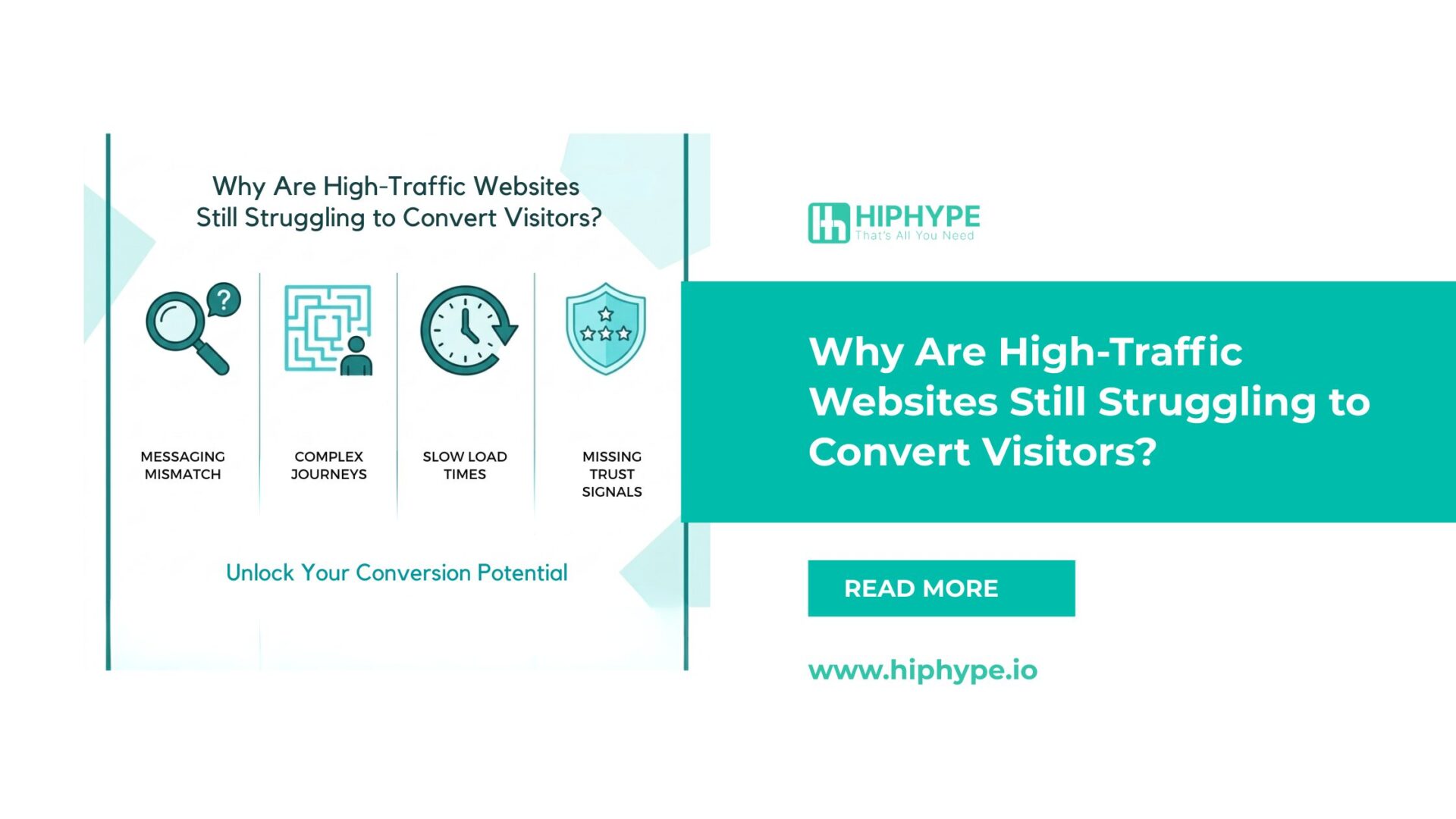
A significant number of websites attract consistent traffic but fail to generate meaningful results such as leads, sign-ups, or sales. This gap highlights a critical issue: traffic alone does not drive business outcomes.
The real challenge lies in what happens after a user lands on the website.
Understanding the Gap Between Traffic and Conversion
Website traffic measures visibility. Conversion measures action.
A conversion occurs when a visitor completes a desired action, such as:
- Submitting a form
- Signing up for a service
- Making a purchase
Many businesses invest heavily in acquisition channels like SEO, paid advertising, and social media. However, they often overlook the on-site experience that influences user decisions.
As a result, high traffic does not translate into high performance.
Key Reasons High-Traffic Websites Fail to Convert
1. Lack of Clear Value Proposition
Visitors form an impression within seconds.
If the website does not clearly communicate:
- What the business offers
- Who it is intended for
- Why it is relevant
Users are unlikely to engage further.
Clarity is essential. Without it, even high-quality traffic will not convert.
2. Absence of Direction for Users
A common issue across many websites is the lack of a defined user journey.
When visitors are not guided toward a specific action, they are left to navigate without purpose. This often leads to drop-offs.
Each page should clearly indicate the next step the user is expected to take.
3. Information Overload
Providing detailed information is important, but excessive content can reduce effectiveness.
Overly dense pages with long explanations and multiple competing elements can overwhelm users.
Modern users prefer:
- Structured content
- Clear hierarchy
- Easy-to-scan layouts
Clarity consistently outperforms volume.
4. Friction in User Experience
Even minor usability issues can impact conversion rates.
These may include:
- Slow loading times
- Poor mobile optimization
- Intrusive pop-ups
- Complex navigation
Such friction reduces user confidence and interrupts the decision-making process.
5. Limited Trust Signals
Trust plays a central role in conversion.
If a website lacks credible indicators such as:
- Client testimonials
- Case studies
- Verified results
Visitors may hesitate to take action.
Establishing credibility is essential for reducing uncertainty.
6. Misaligned Traffic Quality
Not all traffic contributes equally to conversions.
If the audience does not align with the offering, even a well-designed website will struggle to perform.
Common issues include:
- Targeting broad or irrelevant audiences
- Attracting low-intent visitors
- Mismatch between ad messaging and landing page content
Quality of traffic is more important than quantity.
7. Disconnect Between User Intent and Content
Every visitor arrives with a specific expectation.
When the website content does not align with that intent, engagement drops.
For example:
A user seeking a solution may leave if presented with only general information.
Alignment between intent and content is critical for conversion.
What Drives Better Conversion Performance
Improving conversion rates requires a focused approach:
Clear and Focused Messaging
Communicate the core offering in a concise and relevant manner.
Defined Calls-to-Action
Provide clear, actionable steps that guide users toward conversion.
Optimized User Experience
Ensure the website is fast, accessible, and easy to navigate across all devices.
Strong Trust Indicators
Incorporate proof elements that reinforce credibility and reliability.
Alignment with User Intent
Design content and structure based on what users are actively seeking.
Impact on Business Performance
Improving conversion rates allows businesses to:
- Maximize value from existing traffic
- Reduce dependency on constant acquisition
- Achieve more efficient marketing outcomes
This approach shifts the focus from volume to effectiveness, resulting in more sustainable growth.
Conclusion
High traffic may indicate strong visibility, but it does not guarantee meaningful results.
The real measure of a website’s effectiveness lies in its ability to guide visitors toward action. When users leave without engaging, the issue is rarely about reach—it is about how clearly the website communicates value, builds trust, and supports decision-making.
Improving conversion is not about adding more elements or increasing complexity. It is about removing friction, sharpening focus, and aligning the experience with user expectations.
Businesses that prioritize these factors are better positioned to turn existing traffic into measurable outcomes. Instead of continuously investing in acquiring more visitors, the focus should shift toward making every visit more effective.
In a competitive digital environment, sustainable growth comes from optimizing what you already have, not just expanding it.